
Arrowword & Swedish Crossword – Play Online for Free
An arrowword has no separate list of clues: they are printed right in the grid, in the squares that would be black in an ordinary crossword, and arrows show where each answer goes. British publishers devote whole magazines to it and sell it as arrowwords, also spelled arrowords or arrow words; it is also known as the Scandinavian or Swedish crossword. According to Scandinavian accounts, the format appeared in the Danish paper Berlingske Tidende in 1948 and in Sweden's Svenska Dagbladet from December 1954; whether Danes or Swedes invented it is still open.
German and Dutch solvers name it after Sweden too, while the French say mots fléchés, "arrowed words". With little room in a box, the clues are terse: often a synonym, sometimes a scrap of general knowledge. Some magazine prize puzzles have you spell a word from marked squares, and so does ours: we call it the hidden word. Every arrowword here can be solved online for free with no sign-up, and the next one is a click away.
Arrow, Clue Box, Hidden Word: How to Solve This Arrowword
Each clue sits in a light green cell inside the grid, and a small black triangle in the next cell shows where the answer runs: right along the row or down the column. Every puzzle holds at least 25 answers, often more, packed as tightly as the grid allows, and each one runs up to the next green cell or the edge.
- Picking a clue: Click a clue cell to select its answer; the cursor goes to the first free square. The clue lights up yellow and appears again in large type beside the grid, under "Clue". On a phone, where the cells are too small for text, you read it in the line above the keys. Long words in clue cells break with a hyphen.
- Entering letters: Type away and the cursor steps forward one square per letter. Backspace takes the last one back, the arrow keys move from square to square, Tab and Enter jump to the next clue, and at a crossing the space bar flips between across and down.
- Capitals, plain letters: Answers are written in capitals using only A to Z. An accented letter is read as its plain form, so résumé goes in as RESUME.
- The hidden word: Some squares carry a circle and a small number. Read in order, their letters spell the hidden word, and the boxes beside the grid fill up as you write in those squares; click a box to jump to its square.
- Check and Hint: "Check" marks mistakes in red and counts them, ignoring empty squares. "Hint" writes the right letter in blue into the selected square, where it stays fixed; at the end you learn how many hints you needed.
- Finish later: Your grid stays saved in the browser, hidden word included, and "New puzzle" asks you to confirm before it discards your letters.
With these tricks, fewer squares stay blank:
- Short words up front: Answers of three or four letters usually come quickly and hand the long ones their first letters.
- Decode the clue: A clue like "Ship of the desert" explains nothing; it just gives another name for the same thing. Find the word that means the same and count the squares to the next green cell.
- Work the hidden word: Two or three circled letters often give the hidden word away, and with it the other circles: fresh letters for answers that were still empty.
- Think crosswise: Many squares belong to two answers. If a clue resists, solve the word that cuts through it first.
- Look for a second sense: Not every clue means the obvious. "It has a trunk" could be a tree, an elephant or a car. If no answer fits, think of another meaning of the same words.
- Check as you go: A wrong letter travels through the crossings into other words. Check after each finished corner and you catch it before it spoils more answers.
For Your Next Puzzle Break: Five More Games
Caught the solving bug? Here is your next challenge:
- Crossword: The classic sibling, with numbered clues in two lists beside the grid. Its clues are longer, but there is no hidden word.
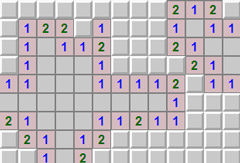
- Minesweeper: Each number shows how many mines border its square. Reason step by step, uncover all the safe ground and flag every suspicious spot.
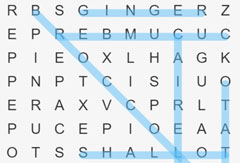
- Word Search: Instead of writing words in, you track them down in a jumble of letters, where they hide across, down, diagonally and even backward.
- Sudoku: Logic instead of vocabulary. Fill nine by nine squares with digits so that none repeats in any row, column or block.
- Memory: A memory workout with face-down cards: flip two per turn, remember where each one lies and clear every matching pair.