



Baker's Freecell – Play Online for Free
Baker's Freecell, also known as Baker's Game, is the predecessor of all Freecell variants. The game was designed by C.L. Baker, who introduced it decades before Freecell became the version most players know today. The only rule change between the two games sounds minor, but it transforms the experience entirely: instead of alternating colors, you must stack cards by suit. That single constraint makes Baker's Freecell significantly harder to solve, and not every deal has a solution. If you can clear Freecell without much trouble, this is the challenge you have been looking for.
A Game for Strategists
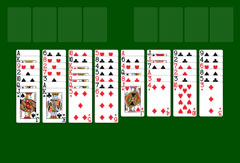
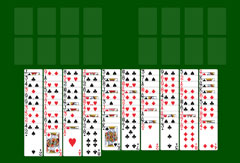
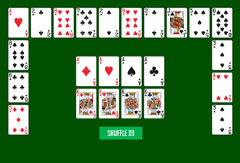
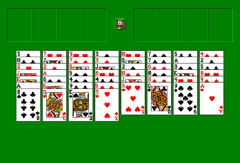
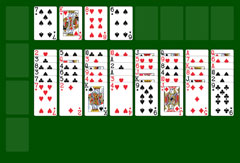
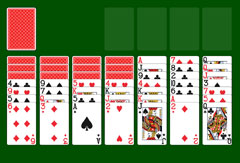
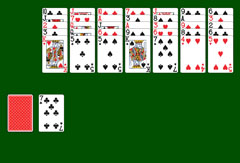
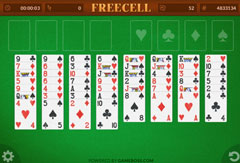
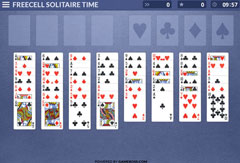
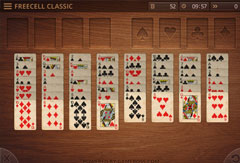
A game begins with one standard 52-card deck, all 52 cards face up. Eight columns are dealt: the four left columns contain seven cards each, the four right columns six. Four free cells in the top left allow you to park individual cards temporarily. Four foundation spaces in the top right must be filled to win.
As in all Freecell variants, the foundations are built by suit from Ace up to King. The key difference from classic Freecell is how columns are built: cards must be stacked in the same suit, not alternating colors. A 3 of Hearts can only go on a 4 of Hearts; a Queen of Clubs only on a King of Clubs.
This significantly limits your options. In all other respects, the same rules apply:
- Use the four free cells to park blocking cards.
- Empty columns can receive any card or valid sequence.
- To move a sequence, you need enough free cells and empty columns to rearrange the cards individually.
When all foundations are started and no card above is blocking one below, the tableau solves itself and you win. If no moves remain: undo back to the point where things went wrong, restart the current game, or start a new one.
How to Play Baker's Freecell
Choose Easy, Normal, or Hard. A time limit of up to 59 minutes and 59 seconds can also be set. The layout matches Freecell Solitaire: 52 cards in eight columns, free cells top left, foundations top right. Cards can be dragged to a new position or clicked to move automatically.
The game menu offers:
- Restart the current game.
- Start a New Game by clicking a difficulty level.
- Undo or Redo moves.
- Hint shows a possible next move.
- Pause stops the game and the timer.
- View elapsed time or remaining time if a limit is set.
- See the number of moves made.
Tips for Baker's Freecell
While almost all deals of classic Freecell can be solved, only around 75% of Baker's Freecell deals are completable. The rules are similar but the strategy must change.
Tip 1: Plan before you move. Same-suit sequences are far more restrictive than alternating-color ones, and the free cells fill up quickly. Before making a move, survey the whole board and think several steps ahead. When in doubt, use Undo as your fallback.
Tip 2: Build the foundations quickly. In classic Freecell, leaving low cards on the tableau a little longer can sometimes be advantageous. In Baker's Freecell the opposite applies: every card placed on a foundation frees up space and can open new moves or clear a column entirely.
Similar Games
Baker's Freecell sits within a small family of free-cell solitaire games, each built around the same idea of using temporary holding spaces to reorder columns. Classic Freecell is the most widely played version: four free cells, alternating-colour sequences, and a reliable deal that makes virtually every game solvable with the right approach.
Eight Off takes the concept further by providing eight free cells instead of four, giving you considerably more room to park awkward cards. The trade-off is that only Aces can start a foundation pile and the opening layout differs, which changes the flow of the game from the very first move.