

Backgammon – Play Online for Free
Backgammon is one of the oldest board games in the world and has lost none of its fascination after nearly 3,000 years of history. Greek soldiers at the siege of Troy are said to have played a game remarkably similar to it, according to ancient accounts. The Roman emperor Claudius even wrote a treatise on his favorite game, though it has not survived to this day. The modern version of backgammon gained its widespread popularity in New York in the 1930s.
Setup and Rules
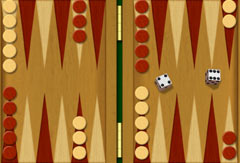
Backgammon is easy to learn, yet offers a depth of play that can engage you for a lifetime. The board consists of 24 elongated triangles called points, divided into four zones: your home board, your outer board, and the two corresponding zones on your opponent's side. The game uses 15 white checkers, 15 dark checkers, and two dice. The objective is to move all your checkers into your home board and then bear them off the board.
At the start of each game, both players place their checkers in the same fixed starting position. The winner is the first to bear off all their checkers.
White checkers are placed as follows:
- 2 checkers on the far-right point of the opponent's home board
- 5 checkers on the far-left point of the opponent's outer board
- 3 checkers on the second point to the left of the midpoint in your own outer board
- 5 checkers on the point immediately to the right of the midpoint in your home board
Dark checkers are placed in a perfectly mirrored arrangement so both players' positions face each other. The player whose home board is on the left moves clockwise; the other moves counterclockwise.
The rules
- To determine who goes first, each player rolls one die; the higher result starts. Ties are re-rolled.
- From then on both dice are always used and players alternate turns.
- You may move one or two checkers depending on your roll. With a 5 and a 2, you can move one checker 5 points and another 2, or combine both values to move a single checker 7 points.
- If both dice show the same value (doubles), the number of moves is doubled. Double 3 allows four moves of 3 points each.
- Moves are made separately for each die. A checker cannot stop or pass through a point occupied by two or more opponent checkers.
- If a checker lands on a point holding a single opponent checker, that checker is hit, removed, and placed on the bar in the center of the board.
- Checkers on the bar must be re-entered onto the board before any other move, using one or both values of the next roll.
- Once all 15 of your checkers are in your home board, you may begin bearing them off. Any roll that would take a checker beyond the board bears it off directly.
- Example: a checker on point 5, another on point 3. You roll 6 and 2. The 6 bears off the checker on point 5; the 2 moves the other checker forward.
Tips for Getting Started
Backgammon has inspired countless tactical recommendations since antiquity, and mastering it shares something with poker or chess: you can learn the basics in ten minutes and spend a lifetime exploring the subtleties. Here are a few fundamentals worth practicing until they become second nature.
Get all your checkers out of the opponent's home board and into your own half of the board before they become trapped. If you delay, they risk being blocked while your opponent has already secured position on the other side.
Occupying points in the opponent's area is generally less effective than building up your own zone. As long as opponent checkers remain on your side of the board, you can slow them with solid blocks: each point in the block must hold at least two of your own checkers, and the block should cover as many consecutive points as possible without leaving gaps. Breaking through such a defence requires considerable luck with the dice.
You can play against the computer or against another person, which is an excellent way to test different strategies and identify weaknesses in your own game.
How Backgammon Works
Select Backgammon from the More Games menu to reach the start screen, where you choose between a computer opponent or a human one. The human option works equally well as a two-player mode at the same screen. The board is displayed in the classic layout with checkers already in their starting positions. In computer mode you are Player 1 (P1).
When it is your turn, a white border flashes around the P1 avatar. Click the dice button on the left side of the board to roll, then select the checker you want to move. The points you can legally reach are highlighted. If a checker cannot be selected, no legal move is available for it given your roll. In special situations, such as rolling doubles, an explanatory message appears. The same happens when you bear off your last checker and win, or when the game ends in defeat.
More Great Games
Backgammon is a competitive game where the challenge lies in making the most of what the dice give you. For something more relaxed, Freecell, Solitaire, and Spider Solitaire offer quiet solo challenges at any skill level. For more action, Uno Online and Bubble Shooter are great options. New games are added regularly, so check back often.